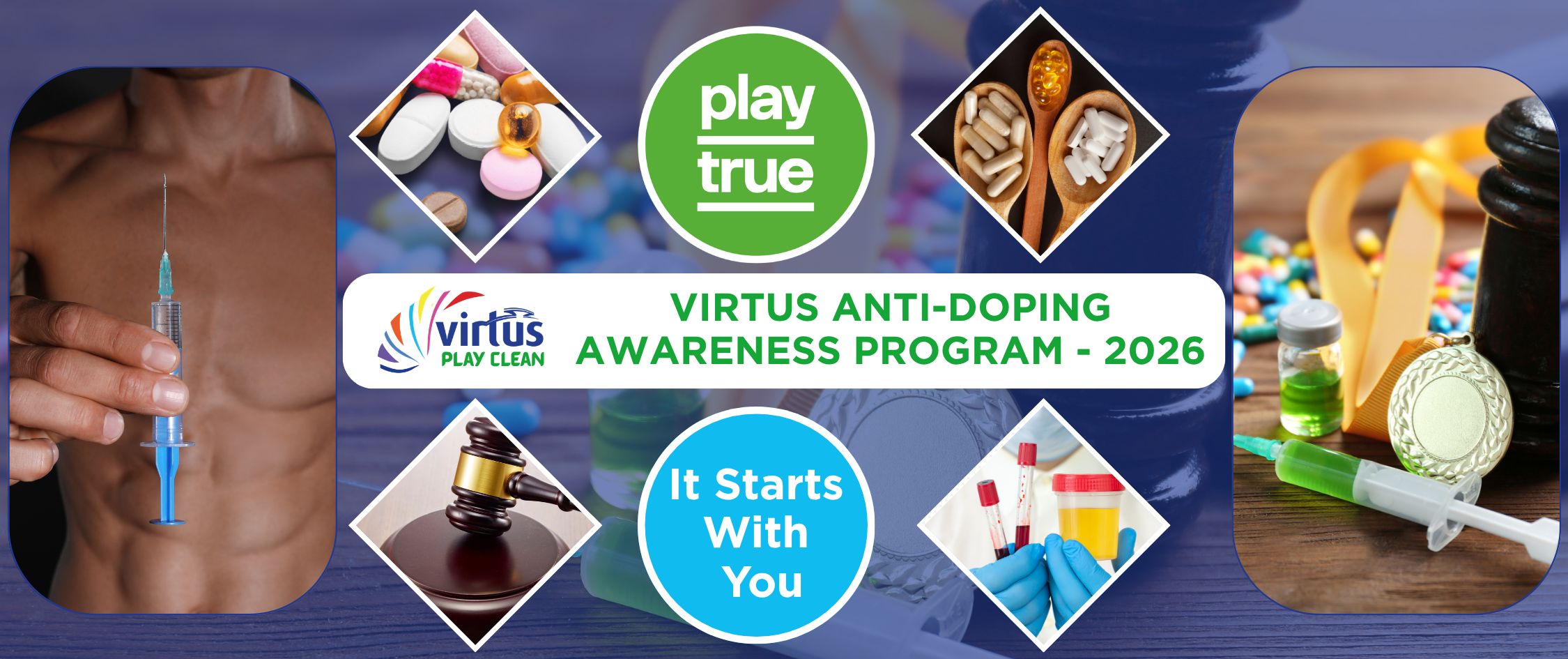
For the third year running, Virtus is proud to launch the Anti-Doping Awareness Program 2026 – our most accessible edition yet, built specifically for athletes with an intellectual disability, their coaches, and the people who support them.

Anti-doping rules are the same for every athlete in the world. But the way those rules are taught doesn’t have to be. Our materials use plain language, clear visuals, and a tone focused on protection – not punishment. Because an athlete who understands the rules isn’t just compliant. They’re empowered.

What’s new this year

2026 brings a fresh set of resources: a dedicated guide for coaches and parents, a redesigned Athlete Guide with quick-access links, a series of educational games for national teams, and a WhatsApp group for real-time updates. Our popular Talk With the Expert YouTube series also returns, with guest speakers tackling the topics that matter most to our community.

We don’t just test athletes. We support them.

Scenerios

The Borrowed Medicine

What happened: An athlete had a headache and asked a friend if he/she has any medicine for the headache. The athlete took the medicine without checking if it was prohibited. The athlete had to take a doping test, and the test came back positive.

The result: The athlete was banned from competing in sports. Even if it was an unintentional/accident, the athlete was suspended/banned because athletes are responsible for what goes into their body.

Golden tip: Never take medicine from friends without checking for banned substances. Always consult your doctor and your Federation!

See the inclusive post on Virtus Instagram and Facebook.

Talk With ‘Experts’ 

Clean Sport Challenge/Games

Hit the Answer

1. Overview and Objectives

The game “Hit the Answer aims to reinforce knowledge about anti-doping and health in a playful manner.

Main Objective: Accumulate the highest score by correctly answering questions aboutthe Athlete’s Guide and demonstrating accuracy at the target.
Pedagogical Pillars: Encouraging teamwork, decision-making under pressure, motor coordination, and awareness of “Clean Sport”.

2. Organisation and Materials

Location: A wide space (court, yard, or adapted classroom).
Participants: Divided into two teams (A and B).
Materials: Balls, question cards, and targets of various sizes (such as buckets, boxes, or floor markings).

3. Game Dynamics

1. Educational Briefing: The teacher explains the question concepts and the rules. Students have 5 minutes to discuss the topic as a team before starting.
2. The Round: Teams form lines in front of the targets (suggested distance of 2 meters, adjustable based on skill level).
3. The Challenge: The teacher asks a question to the first athlete in line.
o If incorrect: The athlete returns to the back of the line, and the team does notscore.
o If correct: The athlete earns the right to throw at the target.

4. Scoring System

Points are based on the difficulty level of the target chosen by the athlete:

Easy (Large/Near target): 10 points.
Medium (Intermediate target): 20 points.
Hard (Small/Distant target): 30 points.

Victory Criteria: The team with the most points after 20 rounds (or after everyone has participated) wins.

5. Adaptations by Sport

The game can be customised using equipment specific to different sports:

Badminton: Use rackets and shuttlecocks to hit the targets.
Table Tennis: Throws or racket hits aimed at marked areas on the table.
Football (Soccer): Accuracy kicks into designated areas of the goal.

6. Question Bank (Examples)

The questions cover athlete responsibility and control rules:

Doping is allowed in sports. (Wrong)
The athlete is responsible for what they put in their body. (Correct)
Fruits and vegetables are part of a healthy diet. (Correct)
Every supplement is safe. (Wrong)
An athlete can be tested for doping at any time. (Correct)
An athlete can evade a doping test. (Wrong)
Sharing medication with another athlete is permitted. (Wrong)
Doping can be harmful to health. (Correct)
An athlete can ask for help during doping control. (Correct)
One should lie during the anti-doping process. (Wrong)
An athlete can use any medicine without asking. (Wrong)
Anti-doping testing can happen out of competition. (Correct)
It is important to report something suspicious in sport. (Correct)
Athletes do not need to know the anti-doping rules. (Wrong)
The goal of anti-doping is to protect clean sport. (Correct)
Athletes must respect other players. (Correct)
Doping helps keep sport fair. (Wrong)
An athlete can request a translator during doping control. (Correct)
A medicine may contain prohibited substances. (Correct)
Athletes do not need to be careful with supplements. (Wrong)
Doping control can use urine or blood samples. (Correct)
An athlete can hide information during a doping test. (Wrong)
Only famous athletes need to follow anti-doping rules. (Wrong)
Being a clean athlete is important for the sport. (Correct)
I should inform my doctor that I am an athlete and undergo anti-doping tests. (Correct)

Virtus is the brand name of the International Sports Federation for athletes with intellectual impairment and is a founding member of the International Paralympic Committee. Registered as a Charitable Incorporated Organisation in the UK (1173901)

© Copyright - VIRTUS 2021