

From Autism Diagnosis to World Records: Rise of Kate Wallington On World Stage
As Virtus marks Autism Awareness Month, it is an opportunity to celebrate athletes whose stories reflect resilience, determination and the power of inclusion in sport. Among them is Australian swimmer Kate Wallington, whose remarkable journey in the pool has inspired both people with autism and the wider sporting world.
Wallington made history at the Virtus World Swimming Championships, where she broke 12 world records in the II3 class for athletes with autism. Her extraordinary performance not only highlights her exceptional talent and dedication, but also demonstrates the incredible potential of autistic athletes when they are given the opportunity, recognition and support to compete at the highest level.
Originally from Perth, Western Australia, Wallington is also a student at Murdoch University, where she studies Exercise and Sports Science. Her rise to international success is a story built on years of hard work, unwavering family support, and a deep connection with the water that has shaped both her life and her career.
Discovering Swimming at a Young Age
Wallington first discovered her passion for swimming when she was a child and started competing when she was seven years old. While she had always enjoyed swimming lessons as a child, it quickly developed into something more serious when she began training competitively. What began as a childhood activity soon became central to her life.
“I always loved swimming lessons, I loved being underwater” she explains.
At the time, Wallington had not yet been diagnosed with autism. She was only diagnosed at the age of sixteen, meaning that many of her behaviours and preferences as a child were not fully understood.
Looking back, she now realises that her love for being underwater may have been connected to sensory experiences, which is common for individuals with autism.
Swimming provided comfort and focus, but it also gave her something else that would prove equally important: structure and routine.
“I love the structure and the routine, I love the pain, I love training every day. It’s not just the racing – I love the process. That’s one of my favourite things about swimming,” she says.
The Support Behind Her Success
Behind every one of Wallington’s achievements is the unwavering support of her family, especially her mother.
Her mother was the one who first asked if she wanted to start swimming competitively when she was seven years old. For years, she drove her to early morning training sessions and competitions, supporting her daughter’s dream long before the international recognition arrived. Wallington dedicates every medal she wins to her family as much as she does to herself.
“Every medal that I win, I think she deserves a prize too. That’s her medal as well.”
She believes that her success represents more than an individual achievement. It is also a victory for her family, coaches, friends and the country she represents.
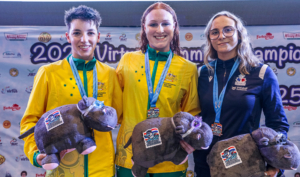
Kate Wallington (centre) celebrating her win with her fellow medallists at the 2025 Virtus World Swimming Championship, Bangkok. Photo Credit: SAIT
Challenges Growing Up Without a Diagnosis
Despite her talent in the pool, Wallington’s journey through school and adolescence was not easy. Before her autism diagnosis, she struggled socially and academically without understanding why. Her daily routine was intense – training before school, attending classes for most of the day, and returning to the pool again in the afternoon. Balancing these demands while masking her autistic traits was exhausting.
“I didn’t do well in school because I was not diagnosed, and so got no support in that aspect and really struggled with the socialising aspect, especially while I was training so much. So I would go from training to school and then back to training in the afternoon, and that meant that I didn’t have time to hang out with my friends from school outside of school, so they thought I was a weirdo. I was masking from five o’clock in the morning till, uh, like seven o’clock at night, and then I’ve struggled with sleep as well, so yeah, I don’t know how I survived. That’s why I developed epilepsy”
Kate recalls masking her behaviour from early morning until late in the evening, trying to fit into environments that did not fully understand her needs. Today, however, her experience in education has improved significantly. At Murdoch University, she finds the learning environment more adaptable and inclusive.
Her course in Exercise and Sports Science closely connects with her life as an athlete, and she hopes to eventually work as an exercise physiologist, particularly supporting autistic individuals.
How Autism Has Shaped Her Journey
Wallington opens up about the ways autism has made both swimming and everyday life more challenging. Competing at international events can be particularly overwhelming due to the intense sensory environment.
“Everything is really overstimulating and really tiring. The bright lights, the sounds, everything about it is a lot,” she explains.
However, swimming itself offers a unique sense of calm.
Being underwater reduces the sensory overload of the outside world. The noise fades, the environment becomes predictable, and the water feels familiar.
“I just feel at home when I’m in the water. I hate being on land,” she says.
Communication has also presented challenges throughout her career. Beyond training and racing, athletes must constantly communicate with coaches, committees and clubs. For Wallington, navigating these interactions has often been difficult, but strong support networks have helped her succeed.
“I’m really lucky to be where I am right now. I have a lot of support around me and a lot of neurodivergent people who understand me,” she says.
Competing in the II3 class
Wallington now competes in the II3 class, a category for athletes with autism within the Virtus competition system. For many years, Kate competed in mainstream competitions before receiving her diagnosis. Competing in the II3 category has allowed her to compete alongside athletes who share similar experiences.
For Wallington, this has been one of the most meaningful parts of the championships.
“It’s amazing getting to see everyone else so proud of themselves and so happy.”
Competing with athletes with autism fosters a sense of shared understanding and mutual respect for Kate. Seeing other athletes celebrate their achievements reminds her how much dedication each competitor has invested in their journey.
A Historic Performance
At the 2025 Virtus World Swimming Championships, Wallington’s years of dedication culminated in an extraordinary performance. After more than 12 years of training, she won gold medals and broke 12 world records, representing Australia on the international stage. Kate was also awarded the ‘Best Female Athlete‘ award for her amazing performance at Bangkok 2025.
The moment she touched the wall after one of her races was unforgettable. Winning a world record and representing her country, she says, is a feeling that is difficult to describe.
“Winning a gold medal and getting a world record – you can’t describe how that makes you feel.”
As Virtus celebrates its 40-year anniversary, we proudly celebrate the resilience, determination and extraordinary journey of Kate Wallington. Her story is a powerful reminder of the importance of representation and inclusion in sport. It shows how understanding, opportunity and strong support can empower athletes with autism to believe in themselves, pursue their dreams and achieve greatness on the world stage.


