
INTRODUCTION
Virtus is the International Sports Federation for athletes with an intellectual impairment and is responsible for managing and overseeing the eligibility process for athletes wishing to compete in all Virtus and para-sport competition in the intellectual impairment classification group. Virtus is recognised as an Underlying Health Condition (UHC) Assessor by International Sports Federations in compliance with the IPC Classification Code (IPC Classification Code).
Eligible Impairments
Eligible impairments within Virtus and para-sport competition are explained below. Please note that not all eligible impairment groups are recognised in all sports or by all International Federations.
II1 – Intellectual Disability
Intellectual Disability is defined according to the World Health Organisation ICD-11 6A00 as ‘Disorders of Intellectual Development’:
‘Disorders of intellectual development are a group of etiologically diverse conditions originating during the developmental period characterised by significantly below average intellectual functioning and adaptive behaviour that are approximately two or more standard deviations below the mean (approximately less than the 2.3rd percentile), based on appropriately normed, individually administered standardized tests.’
Based upon this definition, the Virtus Eligibility Criteria for athletes with an intellectual disability is:
-
- 1. Significant impairment in intellectual functioning which is defined as a Full-Scale IQ score of 75 or lower, and;
2. Significant limitations in adaptive behaviour as expressed in conceptual, social, and practical adaptive skills. This is defined as performance that is at least 2 standard deviations below the mean of, either:
a. One of the following 3 types of adaptive behaviour: conceptual, social, or practical skills
b. An overall score on a standardised measure of conceptual, social and practical skills OR
c. In nations where standardised tests are not available, diagnosis can be made by clinical judgement based on the ‘appropriate assessment of comparable behavioural indicators’ (ICD-11) and;
3. Intellectual disability must be evident during the developmental period, which is from conception to before 22 years of age
Athletes must meet all 3 elements of the criteria to be eligible for consideration for intellectual disability sport and have their diagnosis confirmed by a qualified psychologist or psychiatrist.
II2 - Intellectual Disability and Significant Additional Impairment
A significant additional impairment is defined by Virtus as a lifelong condition that affects the functional capacity of the individual and substantially impacts on their sports performance. This includes athletes who have an intellectual disability, associated lifelong conditions, and/or a genetic condition, such as Down syndrome.
Athletes will be eligible for II2 if it can be demonstrated that they have significant functional impairment in addition to an intellectual disability. That is:
- A formal diagnosis of Trisomy 21 or Translocation Down Syndrome.
OR
2. Have a diagnosed intellectual disability (as defined by the II1 criteria) AND meet the minimum criteria for additional impairment as defined by the Virtus FAST Assessment with supporting medical evidence.
II3 – Autism
Autism or Autism Spectrum Disorder (ASD), is defined by the World Health Organisation (WHO) as ‘persistent deficits in the ability to initiate and to sustain reciprocal social interaction and social communication, and by a range of restricted, repetitive, and inflexible patterns of behaviour, interests or activities that are clearly atypical or excessive for the individual’s age and sociocultural context. The onset of the disorder occurs during the developmental period, typically in early childhood, but symptoms may not become fully apparent until later when social demands exceed limited capacities. Deficits are sufficiently severe to cause impairment in personal, family, social, educational, occupational or other important areas of functioning and are usually a pervasive feature of the individual’s functioning observable in all settings, although they may vary according to social, educational, or other context. Individuals along the spectrum exhibit a full range of intellectual functioning and language abilities.’ (ICD 11).
Both the ICD 11 and the DSM 5 definition of Autism are accepted by Virtus.
Based upon this, the Virtus eligibility criteria for athletes with autism is a formal diagnosis of Autism or ASD carried out by qualified practitioners, using clinically accepted diagnostic techniques.
Completing the application form
Before completing the form, athletes should contact their Virtus Member Organisation for guidance. Please DO NOT contact the Virtus international office directly.
- The form must be completed in English.
- Page 1 and 2 should be completed for ALL athletes by the athlete/athletes representative.
- For all athletes with Down syndrome Appendix 1 (Atlanto-Axial Instability) should also be completed.
The form together with all supporting evidence should then be sent to your Virtus Member Organisation. English translations are required for all submitted documentation not already written in the English language.
The Virtus Member Organisation will complete Page 3 (Eligibility Officer) and Page 4 (Endorsements).
All sections must be completed in full as incomplete applications or those that are not completed properly will be returned causing delays.
Fees and Timelines
Please note that Virtus strongly recommends that all applications are submitted to Virtus at least 12 weeks before the final entry deadline for competition.
A fee is payable to cover the administration costs we incur – this fee increases if the application is sent less than 12 weeks before a competition deadline. Details of the fee levels are available from Virtus National Member Organisations.
Please note that a higher fee does not guarantee a faster turnaround. Whist we try to provide a response on all applications as quickly as possible, this will be affected by factors such as the availability 0f panel members, the number of applications in progress (this rises ahead of all major competitions) and also the quality and presentation of the application.
Note there is no application fee for II1 National Eligibility applications.
Evidential Requirements
Please ensure the following guidance is followed carefully:
II1 - Intellectual Disability
II1 athletes may apply for either a NATIONAL or INTERNATIONAL eligibility registration.
II1 National Eligibility permits entry to national events, youth events and Virtus’ developing sports. It will not permit athletes to enter World and Regional Championships, the Global Games or progress to Paralympic sports classification.
The diagnostic criteria for national and international eligibility are the same, but the evidential requirement for national registration is lower.
Where possible the results of a formal psychological assessment resulting in a diagnosis of intellectual disability should be submitted, however if this is not available, then the following will be accepted:
- A signed statement by a psychologist or doctor which confirms a diagnosis of intellectual disability
- Proof of attendance at a special school/college for students with an intellectual disability
- Diagnosis by state or government for receipt of support, clearly identifying the support required as resulting from intellectual disability, e.g. ICD-11 diagnosis
II1 International Eligibility permits entry to World and Regional Championships, the Global Games and is a pre-requirement for Paralympic sports classification (see appendix #).
A qualified psychologist should make this assessment, taking into consideration the three criteria as set out below. It is essential that they come to a stated diagnostic clinical decision based on a thorough consideration of the athlete’s development history and the clinician’s findings across all three areas, including any additional information they have access to and provide the rationale for this decision.
IQ Assessment
A full and detailed athlete assessment should be undertaken by a qualified psychologist and conclude a clear and unequivocal diagnosis of intellectual disability evidenced by:
Significant impairment in intellectual functioning (IQ=75 and below) – must be assessed using an internationally recognised and professionally administered IQ test. Virtus recognises the most recently standardised variations available in that nation of:
- Wechsler Intelligence Scales – WISC (ages 6-16) and WAIS (ages 16-90) including national and linguistic variations which have been approved by Virtus, such as HAWIE (Germany, Switzerland, Austria), SSAIS-R and MAWIE (South Africa) and MISIC (India). (Note: WASI is not accepted)
- Stanford-Binet (for ages 2+)
- Raven Progressive Matrices (Note: CPM is not accepted)
If previous IQ reports are available, please include these as part of the history of the athlete.
In exceptional circumstances nations can apply to Virtus for a test to be approved specifically for their nation if none of the above standardised tests are available for the population they serve.
Adaptive Behaviour
Significant Limitations in Adaptive Behaviour – must be assessed using an internationally recognised and professionally administered standardised measure that has been norm-referenced on the general population including people with disabilities e.g. Vineland Adaptive Behaviour Scales, ABAS or AAMR Adaptive Behaviour Scales for that nation.
Assessment and reporting should be made in the areas of communication, self-care, self-direction, social/interpersonal skills and ability to respond to life changes and environmental demands. When possible, assessments should not rely on one source of information, but confirmatory evidence should be sought from additional sources.
In countries where no such validated test exists, assessment may be made by rigorous and systematic clinical observations over a period of time, supplemented by additional evidence from records and those who know the person well. Assessment by clinical judgement should:
- Use a wide variety of sources of information (parents/carers, teachers, school records, medical records etc.)
- Should assess ‘typical behaviour’ over a period of time and range of tasks
- Should take account of possible bias
- Should distinguish between Adaptive Behaviour and Problem Behaviour
Assessment should be made in the areas of communication, self-care, self-direction, social/interpersonal skills and ability to respond to life changes and environmental demands. A more detailed report is needed when assessment has been made by clinical observation than when using a formal assessment tool.
Age of Onset
If the athlete is 22 or over Age of Onset (meaning they had diagnosis before age 22) must be demonstrated by a full and detailed developmental including education and family background together with any previous IQ assessment, medical and educational reports undertaken before the age of 22 or by a signed declaration from a current psychologist stating clearly the evidence on which the diagnosis is based.
Assessment Report
The testing Psychologist cannot under any circumstances be the NEO. In the case of both intellectual functioning and adaptive behaviour, the testing psychologist must provide a report that must be no more than 5 years old and:
- Is presented on formal letter-headed paper stating the psychologists name and qualifications, membership number and details of any professional bodies, address, phone/fax number and email
- Is typed (no handwritten reports)
- States when and where the assessment was done (i.e. date, location) and that the assessment was completed in person.
- States the name and version of the IQ test used, the method of assessment of Adaptive Behaviour and why this approach to assessment was chosen.
- Includes information regarding the athlete’s background, developmental history & previous assessments
- Includes a detailed analysis and discussion of IQ and Adaptive Behaviour assessment findings concluding with a clear statement of Intellectual functioning and Adaptive Behaviour.
- Explains any factors which may have affected the results. Particular attention should be paid to cases where there:
- are additional diagnoses, particularly sensory, neurodevelopmental and/or mental health issues
- is a large difference between sub-scale IQ scores that may require the full-scale IQ to be interpreted differently or invalidate it. Reporting should follow the guidelines set out in the IQ test manual and detailed analysis and comment should be included. Where there are substantial sub-score differences, please also provide the GAI score.
- In the case of Adaptive Behaviour assessment, the report should include a summary and interpretation of scores achieved under each domain (Communication
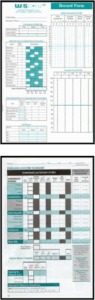
Image1
, Self-care, Self-direction, Social/interpersonal skills, Ability to respond to life changes and environmental demands)
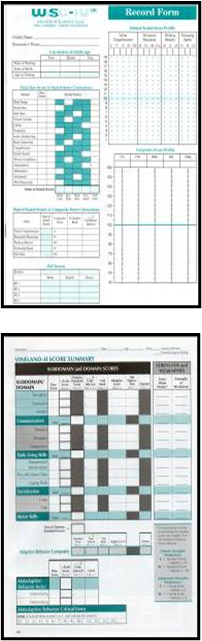
- Includes a copy of the original summary sheet/record form of IQ and standardised Adaptive Behaviour assessments showing all scores. These will be similar to the illustrations shown in Image 1 (right). Where these sheets are not available, the psychologist should explain why within the report.
Includes a clear and unequivocal diagnosis of intellectual disability based on all the available evidence.
Example Report
A sample report template can be downloaded here and may be useful when compiling the necessary reports. This should be shared with the psychologist conducting the assessments. The template is intended as a guide only, and psychologists should use their own report format – it is important however that all requested information is presented and the report is tailored to the individual.
Briefing the Assessing Psychologist
Carrying out a psychological assessment for the purposes of Virtus athlete eligibility has differences from usual clinical practice, hence it is important that these professionals are appropriately briefed and provided with a copy of these guidelines. It is important that they know that their report will be considered only by qualified psychologists experienced in the diagnosis of intellectual disability.
II2 - Intellectual Disability and Significant Additional Impairment
The evidential requirements for II2 vary according to the nature of the additional impairment. There are two routes to apply for II2, one for those with Trisomy 21/Translocation Down Syndrome and one all other athletes (including those who have Mosaic Down Syndrome).
Route 1 – Trisomy/Translocation Down Syndrome
Athletes applying should submit:
- A copy of the results of a blood test (cytogenetic analysis) for that athlete confirming Trisomy 21 or Translocation Down Syndrome. The test should be based on a minimum of 20 cells and clearly diagnose Trisomy or Translocation Down syndrome.
- Evidence regarding AAI should also be submitted, as outlined below.
- Copies of IQ or Adaptive Behaviour tests and other information relevant to II1 eligibility are not required for this route.
Route 2 – The FAST assessment for all other athletes (including athletes with Mosaic Down syndrome)
Athletes applying for II2 using Route 2 must already hold – or must also apply for – II1 eligibility. The testing Psychologist cannot under any circumstances be the NEO
Athletes should submit:
- An II1 application including all evidence described above (unless II1 eligibility is already held)
- A completed Virtus FAST Assessment form with overall score.
- A brief description, including medical diagnosis, of the main additional impairments for which II2 eligibility is sought.
- Detailed medical supporting documentation for the additional impairment;
- Details of ‘best performance’ in the sport/event with year and competition.
- Translation of the above into English.
We strongly urge all applicants to review the FAST guidance here before beginning the application process.
PROVISIONAL STATUS
Athletes who meet the II2 FAST criteria will initially be given ‘provisional eligibility’. Full eligibility will only be given after observation in competition which we normally aim to complete within 6 months, however this may be extended at Virtus’ discretion.
During provisional status, athletes may not compete in the II2 group in any Virtus World or Regional Championships/Games (although will be eligible in II1) nor achieve any ranking position until II2 status is confirmed.
Any significant inconsistency in the overall expected performance in competition compared to submitted best performance may result in ineligibility for II2 or continued provisional status pending further investigation and observation.
The ‘FAST’ ASSESSMENT
The ‘Functional Assessment Screening Tool’ (FAST) has been developed by Virtus and is derived from the taxonomy of the World Health Organisation’s International Classification of Functioning Disability and Health (ICF), a classification of health and health-related domains.
It provides an initial assessment of the impact of additional functional impairment on the sports performance of the athlete. This must then be verified by medical evidence.
If the criteria for the FAST screening is met the athlete will be asked to provide medical evidence of the Underlying Health Conditions which have led to these additional significant impairments. Evidence should include:
- Identification of the health condition which has led to these impairments (e.g. cerebral palsy)
- Provide and link the medical evidence to each of these health conditions (e.g. MRI Scan and medical report.
- Provide any available evidence detailing the limitations and severity caused by this condition (e.g. Physiotherapy report detailing limb movement limitation).
- Do not submit all available medical documentation only that which is relevant to the functional limitations identified in the FAST screening,
The FAST assessment process will normally be delivered by the NEO, however they may choose to delegate this to a suitably qualified person (somebody who has been trained in the use of FAST by the NEO and is a professional within the health area, familiar with completing screening tools). NEO’s have access to a series of resources from Virtus to assist them in delivering the FAST.
To request access to the resources, NEO’s should contact eligibility@virtus.sport
Template Report
An example template for an II2 submission report can be downloaded here.
II3 - Autism
Evidence should be submitted which supports a diagnosis of Autism or ASD. For most athletes the original historical diagnostic report confirming the athlete is autistic will contain the required information. This evidence must meet the following criteria:
- The testing Psychologist cannot under any circumstances be the NEO
- The assessment has been carried out by an appropriately qualified professional or multi-disciplinary team of professionals.
- There is a detailed developmental history focusing on the developmental and behavioural features consistent with ICD 11 or DSM 5 criteria for autism
- The assessment has included direct contact and interaction with the athlete, focusing on the autistic features as defined above.
- Autistic specific tools have been used in the assessment. Those accepted within Virtus are:
- ADOS/ADOS2 (Autism Diagnostic Observation Schedule)
- ADR-I (Autistic Diagnostic Interview – Revised)
- CARS (Childhood Autism Rating Scale)
- DISCO (Diagnostic Interview for Social and Communication Disorders Framework)
- GARS (Gilliam Autism Rating Scale)
- Adult Asperger Assessment (AAA)
- RIMLAND (Autism Diagnostic Instrument)
- Autism Spectrum Rating Scales (ASRS)
- Indian Scale for the Assessment of Autism (ISAA)
It is important that a formal autism assessment instrument is used that is appropriate to the nationality and spoken language of the athlete and also meets strict psychometric criteria as a valid and reliable measure. For the majority of nations, the tools mentioned above will have versions which can be appropriately used in their nation. In exceptional circumstances nations can apply to Virtus for a test to be approved specifically for their nation, when none of the existing standardised tests are available for the population they serve.
In some cases where the above tools have not been used but specific comprehensive evidence has been gathered by a multi-disciplinary team and mapped against either the ICD 11 or DSM 5 frameworks this may be acceptable at the discretion of the eligibility panel.
As many people with autism are now assessed and diagnosed in early life it is common that historical records are used as part of this eligibility process, hence there is no requirement as regards how old these reports are. It may also be the case that the NEO will need to compile a portfolio of documents from different sources and using historical records, this is appropriate but each of the historical reports should include the following information:
- Details of the assessor’s professional qualifications and expertise to assess for autism.
- A developmental history;
- Details of the assessment methods used;
- Full results of the assessment, including scores (if available) for any assessment tools used;
- A detailed analysis and discussion of assessment findings;
- Consideration of any factors which may have affected the results.
- A clear conclusion including a signed declaration stating that in their professional opinion the diagnosis of Autism can be confirmed.
- Translated into English if required.
In the circumstances where a new assessment is carried out for the purposes of Virtus eligibility the following information in addition to the above should be provided:
- The assessment report should be presented on formal letter-headed paper stating the professional’s name and qualifications, professional accreditation membership number and details of any professional bodies, address, phone number and email
- The assessment report should be typed (no handwritten reports)
- An account given as to why an assessment is being made in later life (i.e. why was this condition not diagnosed earlier?)
- The assessment report must state when and where the assessment or report was completed (i.e. date, location)
Good practice requires:
- Submit only relevant information.
- IQ and AB assessments are not required unless they are being used to substantiate the diagnosis of autism.
- Primary assessments of Autism are required, for example it is not sufficient that a report by Dr X in 1990 refers to an assessment report done by Dr Y in 1985 which confirmed the diagnosis of autism. Please submit the original report by Dr Y.
- If the athlete has been attending services specifically for people with Autism please provide evidence of this.
- Do not only partially translate documents such as medical reports. The assessing panel need to see the context of the report and if there are any contra-indications or reservations about the accuracy of the diagnosis.
- The testing Psychologist cannot under any circumstances be the NEO
Template Report
An example report template for II3 applications can be downloaded here.
Additional information for Athletes with Down syndrome
Athletes with Down Syndrome (DS) are our largest population within II2, combining intellectual disability and significant additional impairment.
KarotypeInformation
The extra chromosome 21 present in a cell alters its metabolism and function. If it is a brain cell this alteration brings about intellectual impairment, poor coordination and balance, neurovegetative disorders affecting response under stress; if it is a muscular cell the effects will be less tone, force, resistance and endurance, more fatigue.
The karyotype will show the presence of the extra chromosome 21 that creates the impairments. The question that arises immediately is are all the cells in the body carrying the anomaly (complete trisomy 21) or only some of them amidst normal cells (mosaicism)?
The reason why complete trisomic cells or mosaic trisomy cells exist is because of the time at which the erroneous (aneuploid) cell division occurred: before conception, at conception or later in early embryonic differentiation.
Cytogenetic testing and implications for Virtus guidance
When we do a classical cytogenetic test (observation of white blood cell division under a microscope) on a blood sample we shall receive information regarding the body parts(tissues) that share an early common embryonic stem with blood cells, these are muscles, joints, bones, connective tissue. Examining many cells under the microscope allows to find out if some normal cells coexist with trisomic cells; this is the mosaic definition. If a muscle has only few trisomic cells (low level mosaicism) it will be stronger but if all cells are trisomic then the muscle will be much weaker, thus the lower the level of mosaicism the lesser the impairment. For this reason mosaicism must follow the FAST route.
By far the most common karyotype tests examine 20 cells bearing some incertitude, mosaicism from 14 to 21% of normal cells will be missed (confidence 95%) meaning we shall have in the same group of athletes some with 80% of trisomic cells together with others that have 100% of trisomic cells in their muscles, this is the technical limit of the most frequent test of 20 cells.
The cost/benefit of this 20 cells test is considered acceptable, examining many more cells (100) is costlier so are the quantitative molecular karyotype tests that yield more precise results than the 20 cells test, very similar to a 30 cells test, the new NGS tests are the gold standard but their costs are high.
In case of doubt about lower levels of mosaicism Virtus asks for a minimum of 30 cells to be examined in order to better detect mosaicism .
References
Ozkan E, Lacerda MP. Genetics, Cytogenetic Testing and Conventional Karyotype. [Updated 2023 Aug 8]. In: StatPearls [Internet]. Treasure Island (FL): StatPearls Publishing; 2025 Jan. Available from: https://www.ncbi.nlm.nih.gov/books/NBK563293/
Papavassiliou P, York TP, Gursoy N, Hill G, Nicely LV, Sundaram U, McClain A, Aggen SH, Eaves L, Riley B, Jackson-Cook C. 2009. The phenotype of persons having mosaicism for trisomy 21/Down syndrome reflects the percentage of trisomic cells present in different tissues. Am J Med Genet Part A 149A:573–583
Papavassiliou P, Charalsawadi C, Rafferty K, Jackson-Cook C. Mosaicism for trisomy 21: a review. Am J Med Genet A. 2015 Jan;167A(1):26-39. doi: 10.1002/ajmg.a.36861. Epub 2014 Nov 20. PMID: 25412855.
Rack KA, van den Berg E, Haferlach C, Beverloo HB, Costa D, Espinet B, Foot N, Jeffries S, Martin K, O’Connor S, Schoumans J, Talley P, Telford N, Stioui S, Zemanova Z, Hastings RJ. European recommendations and quality assurance for cytogenomic analysis of haematological neoplasms. Leukemia. 2019 Aug;33(8):1851-1867. doi: 10.1038/s41375-019-0378-z. Epub 2019 Jan 29. PMID: 30696948; PMCID: PMC6756035.
Silva, M., de Leeuw, N., Mann, K. et al. European guidelines for constitutional cytogenomic analysis. Eur J Hum Genet 27, 1–16 (2019). https://doi.org/10.1038/s41431-018-0244-x
AtlantoAxialInstability
AAI is a rare condition that leads to an increased flexibility in the neck joint and can sometimes make a person more at risk of injury in some sports.
Screening for AAI can only be done by a medical professional/physician and involves an x-ray of the neck joint.
Athletes with symptomatic (i.e. diagnosed AAI) may not participate in Virtus competition due to the risk of injury.
Athletes with asymptomatic AAI (i.e. no evidence of AAI) may compete at their own risk subject to the following provisions:
- A doctor or physician signs the application form giving the appropriate clearances.
- Legal consent to compete is given (from a parent/guardian where the athlete is under 18 or without legal capacity to give consent.
- There should be no sign of progressive myopathy (muscle degeneration). Some signs of progressive myopathy are:
- Increase in muscle weakness
- Loss of sensation
- Onset of incontinence
- Alteration in muscle tone
- Decreasing co-ordination
- Diminishing kinaesthetic awareness
- Change in walking pattern
- Pins and needles.
- That neck flexion to allow the chin to rest on the chest is possible.
- That the person has good head/neck muscular control.
A medical practitioner/physician should sign page 3 of the application form. An x-ray report should be attached along with the results of an x-ray screening as evidence.
Athlete Identification and Minimum Age
The application should include a copy of the athlete’s passport. If this is not available then an alternative legal photographic identification document (for example a national identity card or student card) clearly showing the athletes photo, name, citizenship and date of birth should be included. The minimum age of the athlete is that which is set out in the International Federation Rules for that athlete.
Privacy, Storing and Using Information
Virtus will collect personal data as part of the process of athlete eligibility as set out in our Privacy Policy.
Eligibility Master List
In accordance with the IPC Classification Code (article 36.1), all athletes who complete the eligibility process will appear on the Virtus Master list as either Eligible (ie. a registration number has been issued) or ‘Not-Eligible – Underlying Health Condition’ in addition to name, gender, year of birth, nationality and the date of registration.
The Master List is publicly available and athletes must give their consent or entry to competition may be withheld.
Transfer of athlete data is governed by the IPC Standard for Classification Data Protection (link).
Sharing Eligibility (Underlying Health Condition) Information
There are two occasions where Virtus may confidentially share Eligibility/Medical information with a 3rd party:
- To inform and assist the process of sports classification
- When required to do so by law enforcement or agencies such as WADA
In such cases, information will be transferred via a secure electronic environment.
Other
Research is governed by the Virtus Research Code. All data will be anonymised and follow the Virtus Privacy Policy.
Virtus is registered as a Data Controller with the Information Commissioners Office in the UK.
Athletes may request a copy of all personal information held by Virtus as set out in the Privacy Policy.
Remote Assessment
While remote administration of some tests has become more feasible due to advances in technology and increased demand for telehealth services, significant concerns remain regarding the validity and reliability of such assessments conducted outside controlled environments. Key professional guidelines, including those from the American Psychological Association (APA) and the British Psychological Society (BPS), emphasize the importance of standardised administration procedures to ensure the integrity of test results.
Read more...
Remote assessments often lack the necessary environmental control to prevent distractions, interruptions, or unauthorized assistance, which can compromise test standardization. Moreover, not all tests —particularly those requiring hands-on interaction or observation of subtle behavioural cues—translate well to virtual formats. Technical issues such as poor internet connectivity, screen sharing limitations, or device incompatibility further threaten the fidelity of administration, in addition to the purchase of remote versions of those tests available in this format, training etc.
Given these limitations, remote assessments may not provide an accurate or fair representation of an individual’s cognitive abilities and may be open to manipulation. Therefore, in this high-stake context where the integrity of diagnostic procedures is central in-person testing remains the required method to uphold professional, ethical, legal and psychometric standards.
Further Help and Assistance
If you have any questions or need help completing the form, then please contact your Virtus Member Organisation. Athletes, parents/carers and psychologists should not contact the Virtus international office directly.
Read more...
Member Organisations needing further support should contact Virtus at eligibility@virtus.sport. Please do not send eligibility questions/applications to other Virtus email addresses as this will cause delays.
References
For more information about the definition and assessment of intellectual impairment, visit:
- Virtus National Member Organisations
- Virtus Eligibility Policy
- World Health Organisation International Classification of Diseases Version 11- ICD-11 (available in 10 languages)
- IPC Classification Code
- American Association on Intellectual and Developmental Disabilities
- International Association for the Scientific Study of Intellectual and Developmental Disabilities
Additional Information for Member Organisations
Virtus Member Organisations should also read the guidance below.
Read more...
Submitting the application
Applications may only be submitted by a Member of Virtus in good standing.
- The application form, reports and all evidence should be scanned into pdf format in the order:
- Application form
- Psychological reports OR diagnostic evidence of Trisomy/Translocation Down syndrome
- FAST Assessment + supporting medical information + personal best performance data
- AAI clearance (for all athletes with Down Syndrome)
- Passport/ID copy
- For reports not in English, translations plus the originals should be provided.
- A copy of the athletes photo will also be needed (jpeg or png format)
We strongly recommend that applications are received by Virtus at least 12 weeks before a deadline to appear on the Master List. Late applications incur additional costs.
