
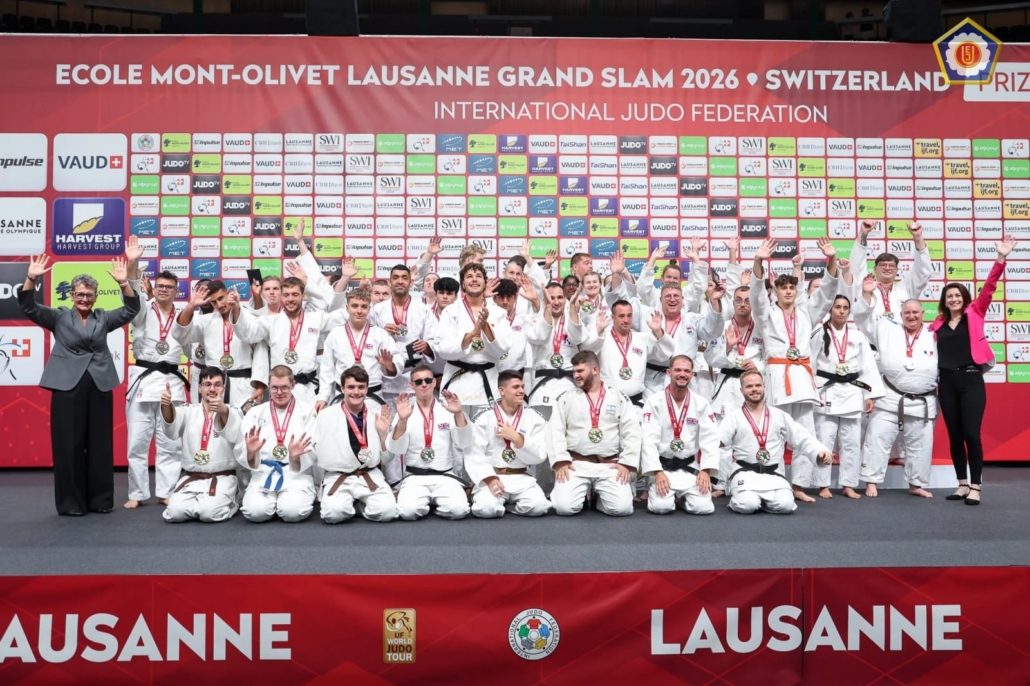
Adapted Judo Marks New Era For Inclusion At Lausanne 2026 Grand Slam
Lausanne, Switzerland — A new chapter in inclusive judo was written in Lausanne as athletes with disabilities stepped onto one of the sport’s biggest stages, competing as part of the inaugural Ecole Mont-Olivet Lausanne Adapted Judo Grand Slam.
Held on 28 August 2026 at the Vaudoise Arena, the competition marked the first time in the history of the IJF World Judo Tour that adapted judoka competed within a Grand Slam environment, alongside the world’s leading mainstream judoka.
For the athletes, this was about much more than taking part in a prestigious event. They came to Lausanne to compete for medals, perform at their highest level and experience the same international spotlight as their mainstream counterparts.
The competition featured athletes in Level 1 and Level 2 divisions, bringing together an increasingly international adapted judo community. Fifty-six athletes from 13 nations had initially been registered, while the wider competition ultimately saw athletes from 12 nations claim at least one medal.
Twenty-two athletes with an intellectual impairment took to the tatami at the Ecole Mont-Olivet Adapted Judo Grand Slam in Lausanne, delivering a strong display of skill, determination and competitive spirit.
Great Britain emerged as the dominant force, featuring prominently across the podiums.
In the -57kg Seniors Level 2, Siobhan Lloyd (GBR) claimed gold, with teammate Nikki McDermott (GBR) taking silver and Mai-Ly Thessens (SUI) securing bronze.
Great Britain also produced a one-two finish in the -81kg Seniors Level 1, with Idris Khan taking gold ahead of Christopher Murphy, while Nir Abelson (ISR) completed the podium with bronze.
In another strong international contest, Gal Morag (ISR) claimed gold, followed by Marco van Kaathoven (NED) with silver and Dion Sassen (NED) with bronze.
The results highlight the growing international field in adapted judo, with athletes from across Europe and beyond competing on the same stage.
Full results are available on the IJF website.
The competition demonstrated that inclusion is about more than participation. Adapted judoka are athletes with ambitions, competitive goals and the ability to pursue excellence.
Lausanne also brought elite, adapted and deaf judo together under one roof, creating a shared environment built around the sport’s core values of respect, friendship and mutual understanding.
With adapted judo continuing to develop international pathways, the Lausanne Grand Slam showed what the future can look like: one sport, one tatami and equal opportunities to compete and succeed.
For adapted judo, Lausanne was not just another competition. It was a step towards a more inclusive future.


