
Virtus Academy: Building a Legacy of Research, Education and Opportunity
When the Virtus Academy was launched in 2021, it marked a new chapter in Virtus’ history. For the first time, research, education, training and knowledge relating to sport for athletes with an intellectual impairment were brought together through one global platform.
The Academy was created to strengthen the scientific evidence behind decision-making and strategy, support coaches and volunteers through education and training, and make valuable knowledge and resources accessible to the wider Virtus community.
Today, it has become an important part of the Virtus movement, connecting research, education and elite sport to help shape the future of opportunities for athletes with intellectual impairments.
A Global Hub for Knowledge
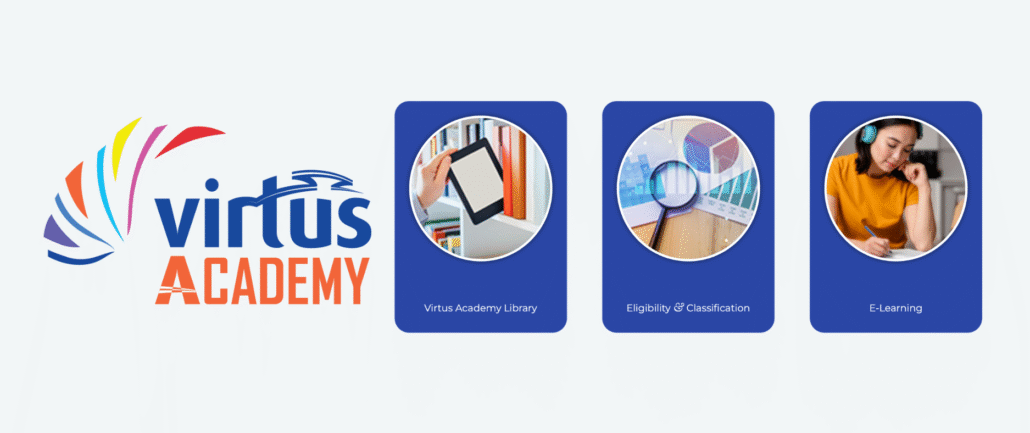
The Academy is built around three key pillars:
- Virtus Academy Library – including high-quality academic research and publications, and sport-specific coaching and other resources supporting the development of sport.
- E-Learning – collecting a range of digital training courses, webinars and toolkits, based on recent research in sport for athletes with an intellectual impairment to support coaches, officials and administrators.
- Eligibility and Classification Zone – training and guidance for psychologists, and support for International Federations developing classification systems and training classifiers.
The Academy website launched alongside the initiative, including the RAID database, a searchable collection of existing guides and research. Since then, it has continued to grow through eLearning courses, webinars, toolkits, training and new resources.
Virtus Academy manager, Dr Debbie Van Biesen, highlighted the Academy’s ambition to bring together existing expertise while growing the evidence base so that Virtus’ work is guided by science and the latest available evidence.
Research Driving Change
Research has remained at the heart of Virtus Academy and, in many ways, its foundations were shaped through Virtus’ involvement in the Erasmus + IDEAL research programmes.
In 2017, Virtus joined the Erasmus+ funded IDEAL (Inclusive and Equitable Sport for People with Autism and Intellectual Disability) project, coordinated by KU Leuven and delivered through a European consortium of researchers, sport organisations and disability experts. Built around five principles, Include, Develop, Educate, Activate and Lead, the project sought to improve access to sport and physical activity for young people with intellectual disabilities and autism spectrum disorder.
The project produced a range of practical resources for coaches, support staff and sport organisations, while also establishing a strong European network of researchers and practitioners dedicated to advancing inclusive sport. Virtus played a central role in translating research into practice through the development and dissemination of educational resources and by promoting the achievements of athletes with intellectual impairments.
Building on its success, the consortium secured a second major Erasmus+ grant for IDEAL 2.0, launched in 2022 and again coordinated by KU Leuven. The project responded to emerging challenges following the COVID-19 pandemic and focused on creating more equitable opportunities for participation, developing evidence-based coach education, addressing barriers to physical activity, and fostering leadership and employability skills through sport. Recognising that sport can be a powerful vehicle for personal development, IDEAL 2.0 supported young people with intellectual disabilities and autism to develop confidence, communication and self-determination skills that are valuable both within and beyond the sporting arena, including for athletes progressing through elite sport pathways.
Together, the two IDEAL projects attracted substantial European funding and generated a lasting legacy that extends far beyond their original objectives. They strengthened international collaborations, expanded the evidence base for inclusive sport, created educational resources that continue to support coaches and organisations worldwide, and helped lay the foundations for the creation and growth of the Virtus Academy as a global hub for research, education and knowledge exchange.
A Partnership with KU Leuven
The Academy’s work has been strengthened by its longstanding collaboration with KU Leuven, Belgium, including the IDEAL 1.0 and IDEAL 2.0 projects and research into evidence-based classification.
In March 2026, Virtus and KU Leuven announced a renewed collaboration aimed at advancing inclusive, equitable and credible research in Para sport. Together, the organisations function as a hub for promoting research in this field and connecting an international network of scholars. Through this network, emerging researchers complete Masters and Doctoral projects on topics related to sport and intellectual impairments, strengthening both the evidence base and the longterm capacity of the field. In doing so, the collaboration supports the development of a sustainable workforce equipped to contribute as researchers, classifiers and coaches into the future.
This partnership and the collaborations it forges connect high-quality academic research producing significant impacts to address the practical needs of athletes, coaches, classifiers and sport organisations while also contributing to wider clinical and societal knowledge.
Strengthening Classification for the Future
In 2026, Virtus in collaboration with academic partners and International Sports Federations, reached another major milestone after receiving two IPC Sport for Mobility Classification Research Grants in a highly competitive process where only 6 out of over 60 applications were funded.
The first, Revalidation and extension of the Generic Sports Intelligence Test (GSIT), is being delivered with KU Leuven to improve the functionality, reliability and validity of the revised GSIT and extend its use across more sports in collaboration with multiple International Federations. The GSIT is used to make sure the athlete meets the Minimum Impairment Criteria (MIC) as part of the IPC-governed classification procedure used by International Federations.
The second, X-Pace: Pacing as a key cognitive determinant of performance in cross-country skiing, is being conducted with Mid Sweden University. It examines cognitive factors such as planning, anticipation and real-time adaptation in cross-country skiing, and will complete the development a sport-specific, evidence-based II classification system for this sport.
Together, these projects support Virtus’ priority of strengthening the quality, credibility and scientific rigour of Paralympic classification. The research supports established Paralympic pathway sports including athletics, swimming and table tennis, while also helping International Federations who are opening up new pathways for athletes with intellectual impairments to implement a classification system not only compliant with the IPC Classification Code but delivers best practice classification.
Building the Future
The Virtus Academy is more than a research platform. It connects science, education, sport and people, ensuring knowledge can reach athletes, coaches, researchers, classifiers, volunteers and international sport organisations.
As Virtus celebrates 40 years, the Academy represents an important part of its modern legacy. In just five years, it has grown from an online launch into a global platform for research, education and training, helping turn scientific knowledge into greater sporting opportunity.
From its first resources and research projects to international academic partnerships, attracting significant funding and major classification initiatives, the Academy is helping build a stronger, fairer and more inclusive future for athletes with intellectual impairments.
Visit the Virtus Academy website, where you can access these resources and become part of this community: https://thevirtusacademy.com/

