
The Story of the Birth and Evolution of the Virtus Global Games
From its beginnings in Sweden in 1989 to becoming the world’s leading multi-sport event for high-performing athletes with an intellectual disability, the Virtus Global Games has grown into a powerful symbol of sporting excellence, opportunity and inclusion.
Long before the Virtus Global Games became a landmark event on the international sporting calendar, its story began with a simple but significant step: creating opportunities for athletes with an intellectual disability to compete together on the world stage.
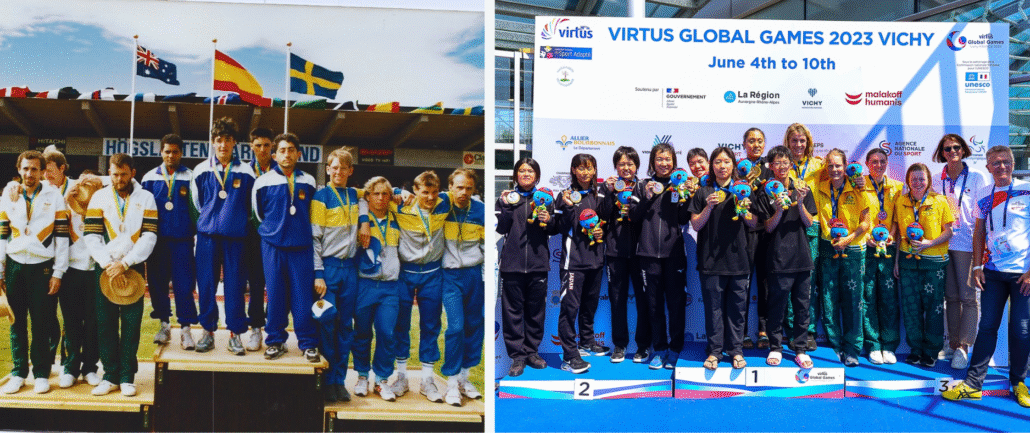
In 1989, just three years after the organisation now known as Virtus was established, the first multi-sport event for athletes with an intellectual impairment took place in Härnösand, Sweden. Known as the 1st World Games for Athletes with an Intellectual Disability, it laid the foundations for what would eventually become the Virtus Global Games.
At the time, the international sporting landscape offered these athletes few opportunities to compete at the highest level. The early Games represented an important effort to bring athletes from different countries together, establish international competition and build recognition for their sporting ability.
What began as an early international gathering would, over the following decades, develop into one of the most significant events in sport for athletes with an intellectual impairment.
The journey towards an international stage
During the early 1990s, the movement continued to expand its international sporting ambitions. Alongside developing its own competitions, the organisation pursued opportunities for athletes with an intellectual impairment to participate in the Paralympic Games. The 1992 Paralympic Games for mental handicap in Madrid marked an important point in this journey, bringing together participants from across five continents while athletes with an intellectual disability competed in Alpine and Cross-Country Skiing at the Tignes Winter Paralympic Games.
Athletes with an intellectual impairment continued to participate in Atlanta 1996 and Nagano 1998 Paralympics, followed by a broader programme at Sydney 2000 that included athletics, swimming, men’s basketball and table tennis. However, the dishonest actions of a small number of people had a devastating impact on all athletes with an intellectual impairment. The entire class was removed from the Paralympic Games after Sydney 2000. The decision left the international community facing an important question: how could athletes continue to access major international multi-sport competition while working towards their rightful place in elite sport?
The answer was to strengthen an event of their own.
The birth of the Global Games
As the organisation looked for a way forward, the idea of establishing a dedicated international multi-sport event gained momentum. José Costa Pereira from Portugal, who had become closely involved in the organisation’s sporting structures during the 1990s and later served as Athletics Director, played a key role in developing the concept, along with Katalin Gruiz from the Hungary and many others who were serving on the governing board and various sport committees.
The name Global Games reflected the ambition behind the event: to bring together athletes from different sports and nations under one international competition. What began as an idea became a reality in 2004, when the first official INAS Global Games were held in Bollnäs, Sweden.
The inaugural edition featured six sports: athletics, basketball, football, swimming, table tennis and tennis. It brought athletes together in a shared international environment and provided a major competition in its own right at a time when access to the Paralympic programme remained restricted.
Bollnäs was more than the location of a new sporting event. It marked the beginning of a recurring international platform where athletes with an intellectual disability could pursue elite sporting ambitions, represent their countries and be recognised for their performances. The success of the first edition established a foundation for the future and demonstrated the potential of a dedicated global competition.
The second Global Games took place in Liberec, Czech Republic, in 2009. The programme expanded to nine sports, including cycling, with early experiences in rowing and judo. Athletes and teams were accommodated around the university, creating a shared environment that helped bring together the different sports and national delegations.
The event also marked a period of adjustment in the competition’s calendar. Following the 2004 edition, the organisers had to navigate restrictions and scheduling considerations connected with the Olympic and Paralympic cycle. The third Games consequently took place in Italy in 2011, one year ahead of the London 2012 Paralympics, with competitions spread across the Liguria region.
Guayaquil, Ecuador hosted the fourth edition in 2015, followed by Brisbane, Australia who the fifth edition. By Brisbane 2019, the Global Games had reached another level. The programme had expanded further and introduced the II2 category for athletes with intellectual disability and significant other impairment (such as Down syndrome, cerebral palsy, etc.) as a new competition class. It also marked a major change in identity: INAS became Virtus, entering a new chapter for the international federation and its flagship competition.
The sixth edition held in Vichy, France, in 2023, was by far the largest Global Games edition in Virtus’ history. Featuring 13 sports, the Games continued the expansion of the programme and the opportunities available to athletes. Vichy was also a significant milestone in the development of the competition classes, with II3 athletes competing for medals for the first time at the Global Games. In addition, both champions from the male – female II1 class in Table Tennis also received a ‘Golden Ticket‘ to the Paris 2024 Paralympic Games, paving an additional pathway to the Paralympics with the support of ITTF.
These developments reflected a broader commitment to recognising the diversity of athletes with an intellectual impairment and creating appropriate opportunities for different athlete groups to compete at an elite level.
Across successive editions, the Global Games evolved from a six-sport competition in Sweden into a major international event spanning a growing range of sports, competition classes and participating nations. Each host brought its own strengths and challenges, helping shape the experience and expectations of future editions.
More than just a competition
The Global Games is more than a medal competition. It gives athletes with an intellectual impairment the opportunity to represent their countries, compete against the world’s best and gain recognition for their performances.
It also strengthens national sporting programmes, develops international connections and highlights the potential of athletes when they are given the right opportunities and support. Alongside its role in elite competition, the Games continues to support Virtus’ wider ambition to expand sporting pathways and advance recognition for athletes with an intellectual impairment.
Looking towards the next chapter
From Härnösand in 1989 to Bollnäs in 2004, and through Liberec, Liguria, Ecuador, Brisbane and Vichy, the history of the Global Games is a story of persistence, adaptation and ambition.

The next chapter will take the Games to a new continent – Africa. Cairo, Egypt, is set to host the seventh Virtus Global Games from 22 November to 5 December 2027, marking the first time the event will be held in Africa. The move represents more than just a new continent. It offers an opportunity to broaden the reach of the Global Games, connect with new audiences and strengthen pathways for athletes in more parts of the world.
As Virtus celebrates its 40th anniversary in 2026, the history of the Global Games is a reminder of what sustained commitment can achieve. An event that began with an early international gathering in Sweden has become a major platform for elite competition, a meeting place for sporting communities and a powerful expression of the belief that athletes with an intellectual impairment deserve opportunities to compete, excel and be recognised.
The Global Games began by opening a door. Across generations of athletes and six official editions, it has continued to widen that opening – with Cairo 2027 set to carry the story forward.

